
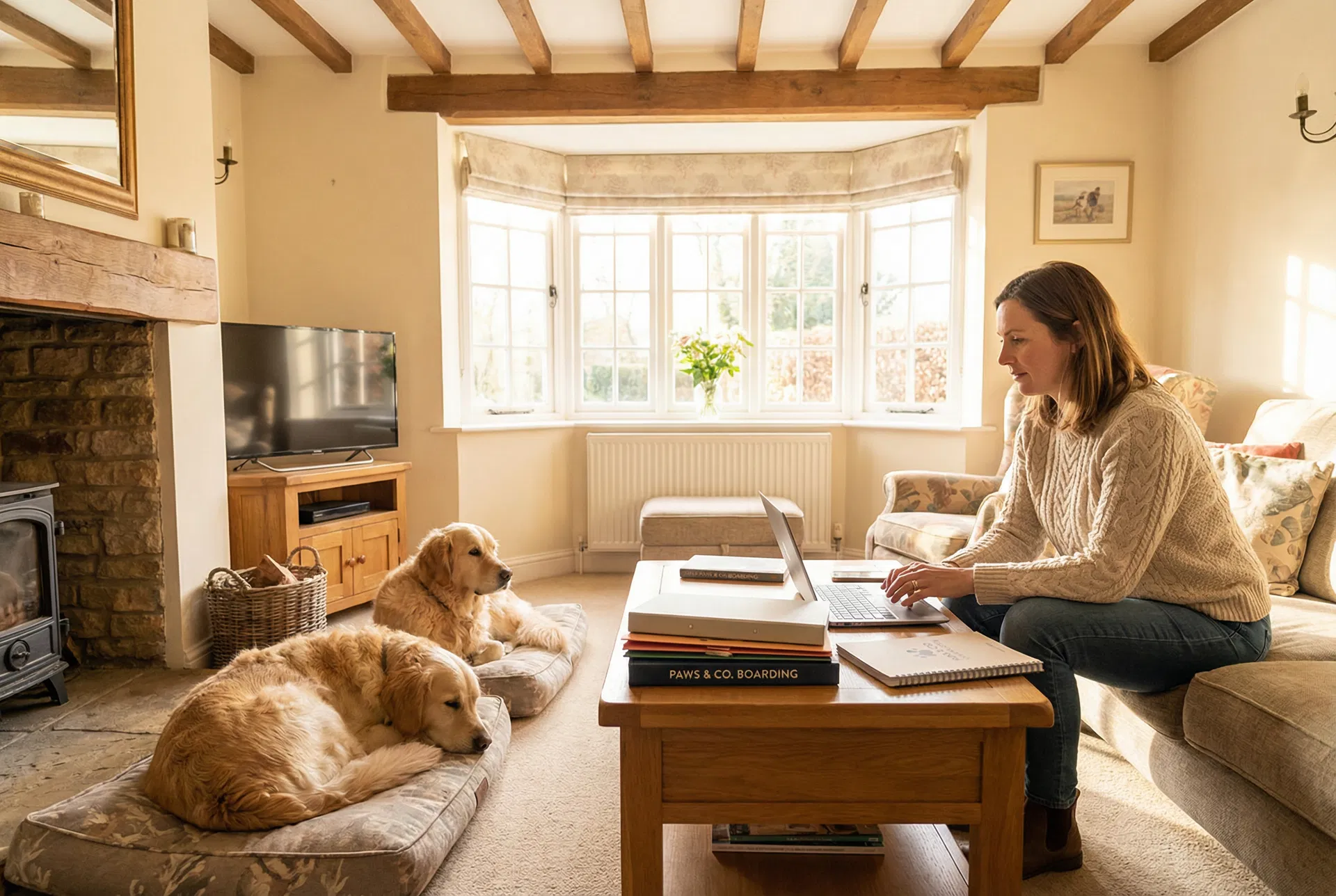
If you're boarding dogs in your home in England and getting paid, you will usually need a licence under the Animal Welfare (Licensing of Activities Involving Animals) (England) Regulations 2018. Wales and Scotland also require licensing for home boarding, but the legal framework and licence format differ.
Some councils may take a pragmatic view where activity is genuinely minimal, but relying on that is risky. Once you are operating as a business, taking payment, and boarding dogs in your home, you should assume licensing applies in most cases and seek formal advice from your local authority.
This page is aimed mainly at home boarders in England, with short notes on Wales and Scotland where the rules differ.
Quick Answer
If you board dogs in your home as a business and take payment, you should assume a licence is required in most cases. In England, licences are issued by the local authority and can run for 1 to 3 years depending on star rating. In Wales and Scotland, licences are commonly renewed annually.
For a focused answer to that question, read: Do You Need a Licence for Dog Home Boarding in England?
What is dog home boarding?
Dog home boarding means caring for dogs in a home environment where they live and stay as part of the household.
This is not:
- Kennels
- Commercial day care
- Outdoor-only setups
Inspectors expect a genuine home environment, not a disguised kennel operation.
Who issues the licence?
Your local council.
They will:
- Assess your application
- Inspect your premises, paperwork, and operating procedures
- Assign a star rating
- Issue your licence
Star rating system: how it actually works
Your rating is based on:
- 1Welfare standards: minimum standards versus higher standards
- 2Risk level: experience, systems, and compliance
If you want a more detailed breakdown, see: Minimum vs Higher Standards Explained (Dog Home Boarding England)
Typical outcome in England
| Star Rating | Licence Length | Meaning |
|---|---|---|
| 1 to 2 stars | 1 year | Higher risk or basic compliance |
| 3 to 4 stars | 2 years | Good compliance |
| 5 stars | 3 years | Higher standards and low risk |
Wales and Scotland
Licences are generally renewed annually, rather than using England's 1 to 5 star licence-length model.
What inspectors actually look for
This is where most people misunderstand the process.
Inspectors are not just checking your home. They are assessing how you operate.
1. Environment
- Clean, safe, hazard-free home
- Enough space for each dog
- Separation areas where required
- Secure garden with no escape points
2. Numbers and suitability
There is no fixed national limit.
Your capacity depends on:
- Your space
- Your setup
- Your ability to manage dogs safely
Poor judgement here is a common failure point.
If you want that point explained properly, read: How Many Dogs Can You Board Legally in the UK?
3. Supervision
Dogs must not be left alone in a way that compromises their welfare.
- Under higher standards, dogs should not be left alone
- Under minimum standards, short periods may be acceptable, typically up to around 3 hours, depending on the individual dog, environment, and behaviour
- You must be able to justify your approach and show it does not cause stress, risk, or welfare concerns
4. Health and welfare
- Vaccination policy in place
- Parasite control
- Isolation procedures for illness
5. Behaviour management
- Safe introductions
- Ongoing monitoring
- Intervention when needed
This is one of the biggest areas inspectors focus on.
6. Records
You must maintain:
- Booking records
- Feeding instructions
- Medical details
- Emergency contacts
What inspectors actually challenge in practice
Inspectors will question you directly.
Expect questions like:
- How do you assess compatibility between dogs?
- What do you do if dogs don't get on?
- How do you manage high-arousal behaviour?
- What happens if a dog becomes ill overnight?
If your answers are vague, inconsistent, or poorly thought through, your rating can drop.
A lot of people come unstuck here, which is why it is worth reading: Common Reasons Dog Home Boarding Licences Get Refused
Minimum standards versus higher standards
Meeting minimum standards is enough to get licensed.
In England, it is not enough to get a strong rating.
Higher standards include:
- Structured enrichment
- Detailed procedures
- Clear risk assessments
- Strong record keeping
- Evidence of knowledge
For the fuller explanation, see: Minimum vs Higher Standards Explained (Dog Home Boarding England)
Key legal requirements, simplified
You must:
- Provide a suitable environment
- Protect dogs from harm
- Meet their physical and behavioural needs
- Maintain accurate records
- Be competent to run the business
What about Wales and Scotland?
Wales and Scotland also license animal boarding establishments, including home boarding, but the system differs from England. Annual renewal is common, and you should check your own local authority's current requirements before applying.
Reality check
Most poor outcomes are not caused by the property itself.
They happen because:
- There is no system
- There is no structure
- The operator cannot explain what they are doing
Inspectors assess competence, not just conditions.
Common mistakes that cause failures
1. No structure
No defined process for:
- Introductions
- Daily routines
- Problem handling
2. Poor group management
Mixing dogs that:
- Are not compatible
- Have not been assessed
- Are not properly supervised
3. Weak documentation
Missing:
- Contracts
- Consent forms
- Veterinary release / emergency authority form
- Emergency plans
4. Overcapacity
Taking on more dogs than can be safely managed.
5. Lack of behaviour understanding
You must be able to:
- Read behaviour
- Prevent issues
- Control arousal
For a more detailed breakdown of where applications go wrong, read: Common Reasons Dog Home Boarding Licences Get Refused
How to prepare for your inspection
Step 1: Set up your environment
- Clear, safe spaces
- Defined rest areas
- Secure outdoor space
Step 2: Build your documentation
At minimum:
- Terms and Conditions
- Service Agreement
- Booking forms
- Veterinary release form
- Master consent and permissions form
- Emergency procedures
Step 3: Define your routine
Be ready to explain:
- A typical day
- Introduction process
- How you manage problems
Step 4: Know your dogs
You must clearly explain:
- Temperament
- Compatibility
- Behaviour patterns
If you want a practical pre-inspection run-through, use the: Dog Home Boarding Inspection Checklist (England)
This is where most people slow themselves down
They try to build everything from scratch:
- contracts
- risk assessments
- procedures
It takes time and it's easy to miss things.
You don't need to do it that way.
Use structured, inspection-ready systems designed specifically for dog home boarding.
Use structured, inspection-ready systems designed specifically for dog home boarding.
Inspection Preparation Checklist
| Area | Done? |
|---|---|
| Environment safe and secure | ☐ |
| Documentation complete | ☐ |
| Emergency plan in place | ☐ |
| Behaviour understanding demonstrated | ☐ |
| Daily routine defined | ☐ |
Want the full version of this in article form? Read: Dog Home Boarding Inspection Checklist (England)
How to get a 5-star rating in England
1. Go beyond minimum standards
Meeting requirements is not enough.
2. Demonstrate control
Show clearly:
- How you manage groups
- How you prevent problems
- How you respond to issues
3. Build proper systems
Structured:
- Processes
- Documentation
- Procedures
4. Show applied knowledge
Inspectors want to see:
- Practical understanding
- Not just theory
If you want to understand the scoring logic behind this, go to: Minimum vs Higher Standards Explained (Dog Home Boarding England)
How many dogs can you board?
There is no fixed national number.
Your limit is based on:
- Your setup
- Your environment
- Your ability to manage safely
Local councils may impose limits.
For the full explanation, read: How Many Dogs Can You Board Legally in the UK?
Do you need qualifications?
Formal qualifications are not always a strict legal requirement in themselves, but local authorities will expect you to show appropriate knowledge, experience, and competence. In practice, relevant training can strengthen your application, support a better rating, and improve credibility with clients.
Relevant training may include Ofqual-regulated qualifications in canine care, welfare, behaviour, handling, and licensing compliance.
Insurance requirements
You need:
- Public liability insurance
- Care, custody and control cover
- Transport cover, if applicable
If you want the full insurance breakdown, read: Dog Home Boarding Insurance (UK): What You Actually Need
Real-world example: what good looks like
A strong setup includes:
- Stable, compatible dog groups
- Structured daily routine
- Clear introduction process
- Defined procedures
- Calm, controlled environment
This only works if the paperwork, risk thinking, and systems behind it are sound. For that, see: Risk Assessments for Dog Home Boarding (UK)
If you're serious about doing this properly
There is a difference between:
- passing an inspection
- running a controlled, professional setup
Most people aim to pass.
Professionals build structure.
That means:
- clear processes
- proper documentation
- consistent handling
- the ability to explain everything you do
You don't need to start from a blank page.
Use structured, inspection-ready systems that will take you most of the way there and remove the common mistakes that cost people their rating.
If you want to:
• pass your inspection first time
• achieve a 5-star rating
• build a properly structured setup
If your answer to any of these is unclear:
- how you assess compatibility
- how you manage conflict
- how your day runs
- what happens if something goes wrong
then your setup needs tightening.
Frequently Asked Questions
Related articles
- Do You Need a Licence for Dog Home Boarding in England?
- Dog Home Boarding Inspection Checklist (England)
- How Many Dogs Can You Board Legally in the UK?
- Common Reasons Dog Home Boarding Licences Get Refused
- Minimum vs Higher Standards Explained (Dog Home Boarding England)
- Dog Home Boarding Insurance (UK): What You Actually Need
- Risk Assessments for Dog Home Boarding (UK)